The Cardinal Chronicles
Menu

Interview with Alan Rosenfeld (1923-2025)
By Anderson Kitzis with Eve Rosenfeld and Reva Strasfeld on April 24, 2024
AR: I know you go up and down in that high rise at Lincoln, is that right? Yeah. ER: The new school… How many years have you been in the new school? I'm a freshman. ER: So this is your 1st year? Have there been any problems? With like going up and down? Yeah. I don't know. I mean, it's pretty tiring because I have some classes up on the 6th floor, which is like the highest one. So it takes a while to get up there. ER: We watched…. We live right up the hill, by Washington… Do you remember the old Lincoln? That’s where Alan went to... AR: We had 1500 students crowded in that building and it faced the park blocks. And…we used to walk to school…Because it was all downhill from where I lived. I lived a couple of blocks from Ainsworth school... We live pretty close. ER: Where are you? We're on Prospect Drive…. What street did you live on near Ainsworth? AR: Laurel Street. It dead-ended where our house was and down below was Montgomery Drive.
AR: Ok let’s go. … What is your name and how old are you? AR: My name is Alan A-L-A-N S. Rosenfeld. And I'm 100 years old. Where did you grow up? AR: I grew up…I was born, up near the city park, where the tennis courts are… my dad had a little house up there, just above those tennis courts, and,...then as the family grew, they moved over to... the address on Southwest Laurel Street. Where did you go to school? ..AR: Ainsworth. And where did you go to high school? AR: Lincoln. How old were you when you went to the Air Force? And were you drafted? AR: No, I wasn't drafted, but in the third year of college…in all the state schools and I was at Stanford, but I also...during the ROTC, which…directs you when you're gonna be called up…and I guess I was about 19 years old when I signed up for that. And what's the advantage of ROTC?...Why did you sign up for the ROTC?.... Was it compulsory? Did they…they pay for college or was it something everybody did? AR:… No, we didn't get paid…. I think all the state schools required you to be in the ROTC. ER: Stanford was not a state school…And because of the... AR: Schooling I had it was in what they call the ordinance. Now, the ordinance were the people that followed the troops and supplied them, maintained their equipment and so forth. And that was division, and when, it got called up. We actually went out on training. to do this type of work, and we were out in the desert, and it was kind of interesting time. But it was at the time when the Germans were headed... toward Saudi Arabia. You know, Germany had no facilities. No petroleum facilities. They manufactured their fuel out of coal...
So then so then you ended up..in the desert…near Saudi Arabia, doing supply stuff or ..when you were saying the desert, which, which desert? AR: No we were just in training. Oh, training... in the desert in the United States in preparation for going to war so that was part of the ROTC. And I went back to Stanford. And because there was no opening in the officers' school for people in the ordinance. And at that time, the Air Force came around, and said, Many of our crews are completing their missions, and we need to re establish new recruits. And that's when I volunteered to go into the Air Force… I was a bad boy. I didn't tell my parents. No really? I think they would have been horrified. Wow, because you were going to leave college to do that. You had to leave college to do it…What year in college were you at the time? AR: Well, I was in... junior year. And we…actually went into the Air Force at what they call pre-flight, which is in Santa Ana. And... from there, it was more or less… discipline training, and they were trying to find out whether you'd be a pilot or... bombardier, or navigator, just what you're, skills were, and I guess, from my…., I was not.. gonna be designated to be a pilot.
Did you continue your education at college after returning from the army? Or the Air Force? AR: Well, it took me three years. Because Stanford didn't have what they called chemical engineering school. They had, engineering classes, and they had chemistry classes, and Stanford was not authorized as a chemical engineering school. So… by a series of timings, I decided to go to the University of Washington and restart my chemical engineering courses. And it took me 3 years. Because they only teach one chemical engineering class per year. And it worked out very well on timing. That's what I was able to do.
What was your role in the Air Force? Bombadier. And tell us a little bit about that. AR: Well, bombardier - the actual planes….I have to go all the way back, we flew at altitude… flew it at 26,000 feet.. There's an airstream from east to west that adds to your... velocity toward the target. So, the planes flew at from east to west toward the target until the bomb site took over, and then the bomb site did its work. And then immediately, you…immediately dropped about 5000 feet and then you headed back. ER: Do I dare interrupt? No, please do. ER: Once you got over the bomb site, and these were, I know what you told me, they were all over Germany. …About how long, once you were at the target area, how long did it take to drop… your bombs? AR: The bomb site took over… you were 10 miles from the target, and it kept adjusting the plane and releasing Not all the planes carried bomb sites, just two – the two front ones, and the rest of the crew’s had a lever, when they saw the bombs drop, they just flipped their lever that released their bombs. And you had to look at the wind and everything, like...? I mean, there's got to be a lot of guesswork..? In terms of wind and other things that can affect the way the bomb falls..AR: Yeah, you put in certain things… Programmed it, yes.
What was your training like? Oh, for the bomb site? ER: For bombardier.. AR: We were up at Walla, Walla, Washington. And,, We actually... trained up there…they had targets and you'd go out, and set in all the…the numbers and, and drop your bombs on target, and they actually… evaluated everybody's… scores. I mean, they had these targets on the ground, and the bombs were filled with sand, and…so your score, as a bombardier, the accuracy was based on actual measurements. Were you pretty good? Were you pretty accurate? Yeah, well, yes. Yeah, I had a pretty high score. Until one — Well, it's a long story, but [ER: not a good story]. This one man, we were gonna bomb at night and it was quite rough. And, of course, if the bomb.., if the plane tipped this way or that way, it would throw the bombs off. Well all the other crews that were in training, decided their pilots…, it was too rough to go out, except my instructor. And he made me go out there and of course, threw my bombs off. They fell everywhere…I had real suspicions that he was an anti-semite.
What kind of airplane were you in? AR: B17G. That was the bomb site. The bomb plane. …ER: Can I add a question? When some years ago, the museum at the Evergreen Museum, you know, that place? There was then, I don't know if it's still there the plane that Alan flew in. We went out there….AR: Not the plane I flew. ER: The same model. And so we were able to see the plane and see, and Alan told us just exactly where everybody sat on the crew. It was an interesting experience. Was that the 1st time you were on an airplane? Did people fly on airplanes before that, or was it just really military plane…the only plane you'd been on? AR: I think... I had not been flying an airplanes. ER: You never flown in an airplane before you trained…..There were very few planes... where passengers flew in those days before...What were the conditions like in the airplane? AR: Very cold. The airplane flew at 26,000 feet. The temperature could be 50 below zero… Of course, at that altitude, you had to be on oxygen all the time..Because they're not pressurized. It was not too... ER: Although, you wore an electrically heated suit, which helped that…category. How many people were in the airplane at the same time? AR: Nine or ten, depending… Most of them were nine. The planes had ten would have a bombardier and an assistant bombardier. And the others would just wouldn't have the bombardiers. And like I say, as soon as they saw the bombs falling out of the planes, they just flipped a switch and dropped their bombs. What they... desire to do in bombing is to take an area, probably 1000 feet in diameter, and have the bombs concentrate on dropping that area, and that.. would be the major target that they were trying to it.
I have a question. Was there any interception by the Germans while you were up there? Were…there German airplanes in the area? Did they try to intercept? AR: There were. Fortunately, early in before we went over, the major targets for the German Air Force, and they were pretty much debilitated when we... flew. So what they would do, they would concentrate what they had left on just maybe one flight of planes.And that's a story in itself. There was one… our planes were all designated with initial on the tail end, and there was one group that the Germans.. had a prior experience with and they, they may concentrate their fighters on that particular group. And unfortunately, that was the group our second mission went on. ER: And you were targeted. Was your plane ever hit… by anti-aircraft? Was your plane ever hit? AR: Oh, my gosh, yes…Was that common? Like, on many of the missions, it would get hit? AR: Yeah. We had couple of missions where we had over fifty hits, and we were very lucky that some of them didn't do damage. I mean, they did damage. One of them, we had two engines knocked out. But the B-17 was a remarkable plane. They could fly it on two engines. And that was a flight where we got- they had two engines knocked out, and we… we couldn't maintain altitude. We just glided on a slow path out of Germany, and we ended up in Reims, France. Have you ever been there? I've never been to Reims. AR: Well, it was the site of the most famous Gothic church in Europe, I guess, maybe in the world, and it's still there. Well, we were coming down, we found out that there was an abandoned airfield there that we could use. We were coming down out of the clouds. And when we got out of the clouds. We were headed directly for the cross with Jesus on top of this. Now, fortunately, when you only have two engines, you don't just go like that. You got to make a very gradual… a very gentle turn. ER: It must have been a skillful [pilot]. AR: And we just missed it…When we landed, it was an old German airfield. But you know, they, it was just past the Battle of the Bulge, and when the Americans started in the Reims, they were almost as bad as the Germans, you know, I mean, they'd been living this terrible life, you know? We actually talked to some of the natives. Of course, we had to explain that we were not not the same kind of people. ER: Those soldiers were rough.
Were there any parts of the Air Force that you enjoyed? Did you enjoy it?.... AR: Our gunnery training was kind of enjoyable. When you shoot a gun, you're moving and the target's moving and it's the same thing. If you ever shot skeet? ..It's the same thing…And when we train in gunnery school, we actually train that way. And they put us in the back of a truck, and drove us down this road at the gunnery school, and we actually fired skeet. Did you ever have like a vacation or like some recreational activities or shows or things like that that you... did? What kind of things..? ER: Talk about your base in England. AR: After this one... Pretty close to after that one where we had to land. We were…given a week's leave and taken to a very famous old, English golf course. They took took our uniforms off gave us golfing dress and golf clubs and it was just very pleasure mode. Well, are you a golfer? I'm a golfer…he is too. We both play. Well, I had played golf on I call it a pitch putt kind of thing. The holes were about a 100 yards, so I knew how to use a 7 and a 5 and a putter. And we went out on this golf course. I was hitting about six strokes to get… to get anywhere near the pin. RS: Well, I told them, how old were you? …He got a hole in one. I think he was…twelve. When he was eleven years old. In Florida. It was an 80 yard shot, and it was with an 8 iron, and it went right in… Beautiful shot.
.
While you were doing the missions, did you know what Hitler was doing during the war? AR: I think we knew that here were.. these concentration camps, but there was no way we could do anything in bombing. Now, the Germans. Incidentally…there were many, many, civilian casualties amongst the Germans, of course. Even from, when our bombs burst, they threw out all these pieces of metal, and people on the ground were… Germans were injured or killed. But we figured this way, that it was almost a compensation between the losses of the Germans, and the losses of.. Jews. It was just about the same number of casualties, so, I don't know. ER: May I ask a question? When you flew over Germany, What were the target areas that weren't necessarily…neighborhood populations? What were your targets? What were they? Were they train depots?.... AR: Military targets. One of the favorites would be a what they call a railroad marshaling yard. You know, that's the same thing they have over on the east side where they have all the trains. And that's where they had supplies loaded. And they showed up very…well there was a device. I think it was developed by the English, where, if you couldn't see that area, it penetrated clouds and because it was, like a magnet, it showed up and they had a way of connecting that to our bomb site. So we could actually bomb through the clouds and…bomb a marshaling yard. Which was a good target because that's the way they move things. Wise.
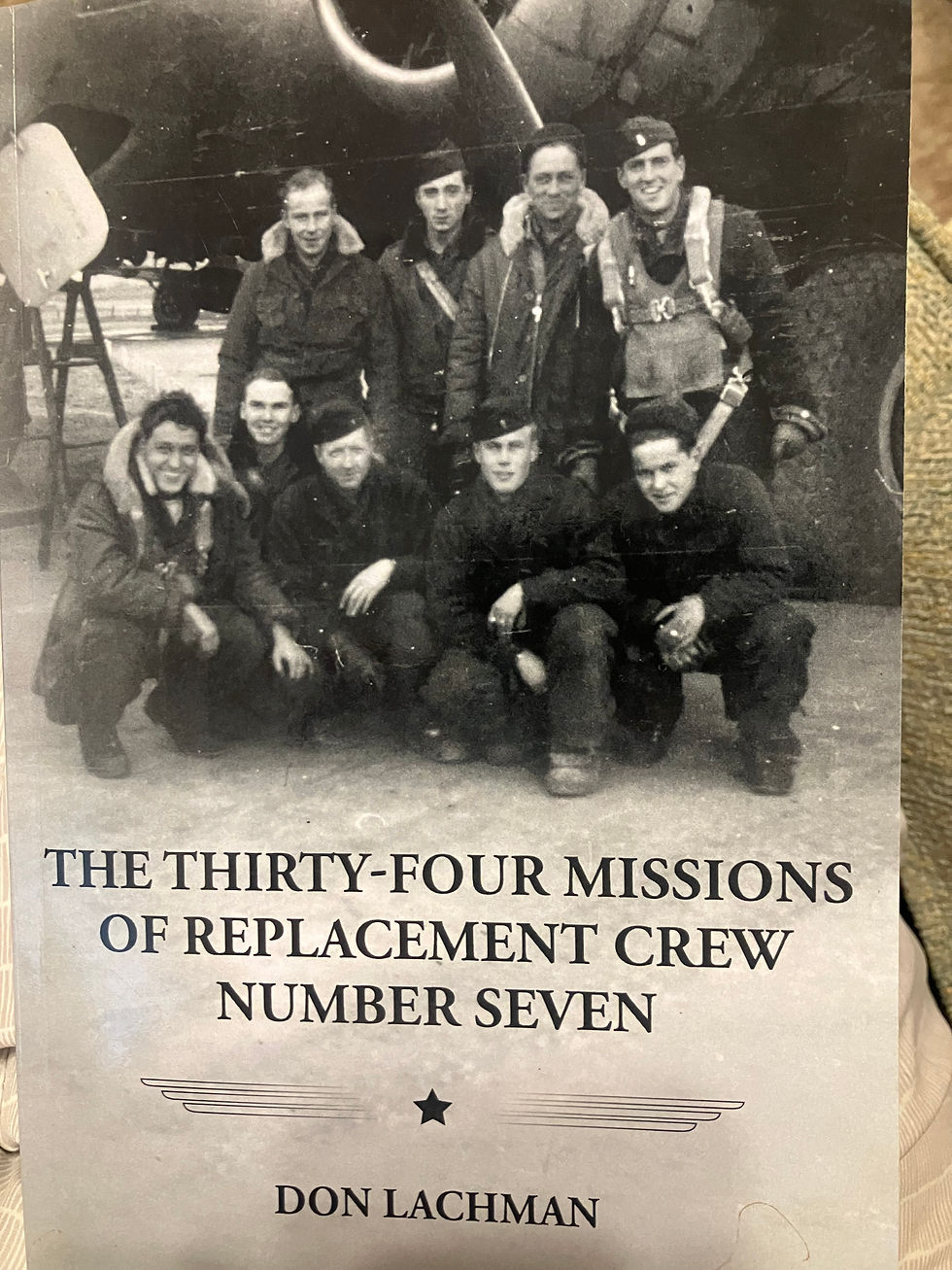
What was it like to be Jewish in the military? Did you experience any anti-semitism or anything like that? AR: Well, I think being Jewish… I say, the only time I really had any problems was - this instructor I had. And being Jewish in the military, we didn't have too much Jewish... experiences at all. RS: Did you ever regret that you signed up for this? Did you ever regret while you were up there that you signed up for this– for the Air Force? AR: You know, I don't really….I don't really know... It must have been - it had to be a frightening experience…ER: Sort of a given. Here I am. You know, this is it? Here I am. Yeah, yeah. You weren't married yet, were you? We had this. Did you show him…the book. AR: Oh, yeah, here's the book..... We'll take a look at that. Which one are you? …AR: This one.
ER: I'm going to ask Alan to describe…the one thing I will do. When you came back from a flight. How did you know whether everybody was okay in the plane? Did you ever find? Was there ever an experience when you'd finish the flight over Germany, you returned to England to the air base, you landed and did you ever find that everybody was okay in the plane or in the group? AR: I mean, they were a group of 35. I don't know how many there were… Our pilot was very good. Even before we started on our bomb runs, he would check on everybody and whether they were okay. We did…wellI don't want to even talk about it, but we did lose... our radio operator. Because of the malfunction of his oxygen system… The book was dedicated to him… The situation was that in the tail gun, there were two stations..well, the one that the gunner operated, of course, was active, and the one opposite him had not been used, and I guess it was frozen up.. . So our radio operator had plugged into that system. And then just didn't get any oxygen... This is the kind of thing you go to sleep every night, thinking about….
How did you feel when the war finally ended? AR: Relief… Yeah, actually, we were down in Texas and we were training to go into B-29s and go to the South Pacific. Well when they dropped the 1st bomb, nothing seemed to happen, and after the second bomb, I think the Japanese decided, surrender, then they turned us up over and said, you guys better go home. When you got back, did you feel celebrated? Were you celebrated and did you feel like a hero? AR: Yeah. I didn't really…celebrate. I kind of put things together and got ready to go back to school. That's one thing I was... interested in your case... But... deciding what direction you want to go, whether you want to go into... The arts or the science is... Do you think about it? I'm think starting to think about it a little bit….I've always liked math. AR: Yeah. Well, that's really a good, good place to be. As a matter of fact, It really wouldn't make any difference if you, later life, you decided to go the other direction, it's always there. You know? Because math, I guess, and art… I'm into art, I guess…And I also like learning about history a lot… stories and stuff. And he had a physics test today that he... physics test. He said he thinks he did well, so we'll see.
RS: I have a question, Alan. What did your parents say when they found out what you were going to do? ER:…I think I'm guessing most parents thought there was no safe place… when the war was on and no matter what you got into nothing was really safe…AR: I don't think they were too happy. ER: It was the lesser of bad choices….That was the way it was… Nothing was good….It was all dangerous. No matter where you were. AR: Well, my brother, actually, was in the army, he was in the infantry, and he was in the South Pacific, and he was wounded pretty… had mortar shell burst, and he had quite a few injuries.. And he used to play the banjo, and he couldn't use his hands…. We had a family orchestra. My dad, when he played the guitar, I played the violin, my brother played a banjo, and we played all the old 30s tunes, you know, popular music….We had a lot of fun together. A lot of family vacations. We always vacation as a family.
Well, I know that you play the violin..for the Jewish community center, right? In their orchestra? AR: Yeah. And they're still today, they come here and rehearsal. And he was a violinist in the orchestra. ER: There are a few of the of the members of the current orchestra that he's still knows. AR: There's about a half a dozen…I played in it for 26 years and... I actually played... in the Portland Junior Symphony, which was the original children's orchestra in the world. And I played in that for three years. And that's where I met – you know, the name Robert Mann. Robert Mann came from South Portland, a poor… a very, modest family. And we used to take him home after our junior symphony practices. So we became good friends, and the Jewish community raised the money to send him to Juilliard, and he founded the Juilliard Quartet, and was very well known internationally.
I'm out of questions, but if you want anything else to share, you can, you're welcome to share anything else. ER: I don't think Alan told you that the way it was...when they started in England, they're flying their missions, it was usual, that was 35 missions… every flight crew had 35 missions, and then they were sent back to the States. AR: Yeah…we only had 34. ER: Oh, they only had 34. ER: The war was winding down. AR: Well, your son does a good job as a server. He really enjoys it. I think he enjoys meeting everybody. That's great. ... Thank you. ER: I hope you got your questions answered. Yeah…it was perfect….