The Cardinal Chronicles
Menu
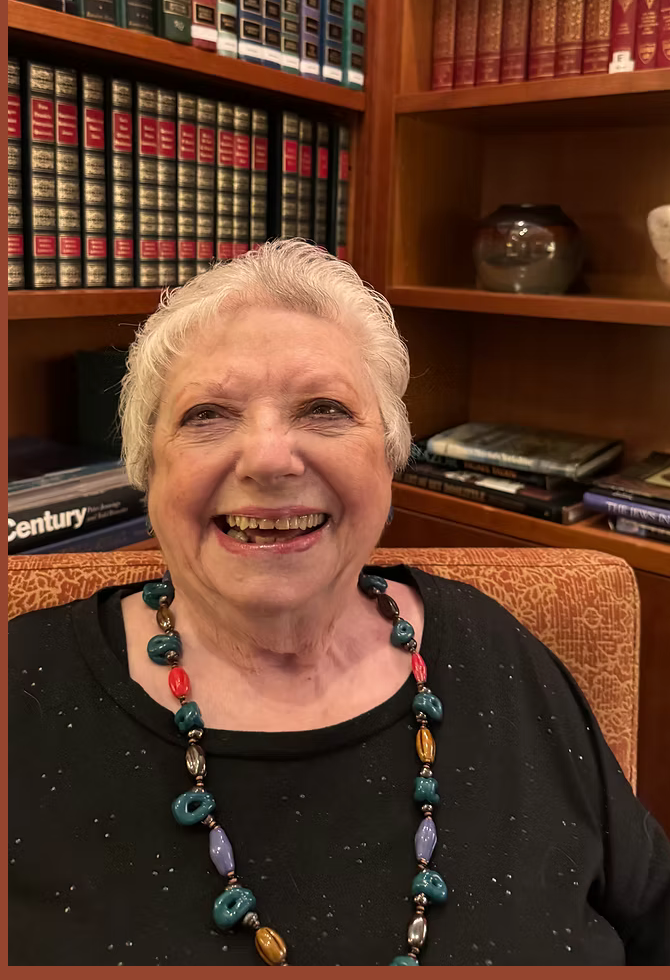

Interview with Beverly Nighorn née Luff (b. 1930)
By Avery Baz and Anderson Kitzis, on January 11, 2026
I just want to start by saying, it's very nice to meet you. My name is Avery. Hi, Beverly.
Hi, I'm Beverly yes… tell me everything about your life. Start from wherever you want. And then we'll ask some questions after. If that's all right. Okay, I'll make it brief still because I am 95, so you don't want it all. Whatever you think is important. When I was 5 years old. It was during the time of Shirley Temple in Hollywood. My parents and I lived in Los Angeles, so, you know, and every mother wanted their child to be another Shirley Temple. And I was my mother's dream. And I took singing and dance. Well, I just took tap lessons at that time, but and also dramatic lessons from a drama school that I went to.
And I went on an interview at Republic Studios in 1936…, for a movie, that they were making where I was to be, one of the, orphans in an orphanage…. And anyway, they wanted a child who could announce things and could sing and dance too, and which I could. So at the end of the movie, the orphanage, which I'm one of the orphans… we thought we had to... raise money to buy the orphanage because the bad guys in the movie wanted to buy the…property that it was on for their own ranches, and there would be no orphanage. So where would we all go? … And this was in the days during the Depression when farmers would adopt children… as supposedly their children, but actually they put them to work. They were cheap labor on their farm. And so none of us, of course, wanted to be adopted for that. And that was the story with, you know, and so forth and so on. And it was a movie, a part of a series with three fellows, the three “mesquiteers.” They were not “musketeers,” but the three “mesquiteers.” And… they were the good guys and they were there in order to save us all. So the kids decide we're going to put on a show. And raise money so that we could buy the property that the orphanage was on and then these bad guys couldn't. Don't ask me where we all got the instruments for the orchestra, of which we had a full orchestra. Or how they supposedly knew how to play them and costumes and so forth, but we're in the big, big,... building in the town. And anyway, we put on a show. So I was the MC, and then at the end of the show, I sang and danced, well, I introduced all of the talent, and then at the end of the show, I sang and danced, and that was that. Wow. And the movie is still around and people keep bringing it up. In fact, they're going to play it again here, one of the women said, I want to see it. So she told them to pull it up, which you can. And they're going to show it again, which is hysterical because it's. What's it called? “Roarin’”, not “roaring”, but “Roarin’ Lead.” And with Republic Studios. And that was that.
Well, I started, you know, with a bang and there I was. I turned 6 on the set. So, you know, I started. That was a big deal. And this was the time of Shirley Temple, and every mother in the Los Angeles area, or I think United States, really, wanted their child to be the next Shirley Temple. Anyhow, from then on, I did a lot of, well, I took drama. I took tap dancing. Tap dancing was my main thing. And I was like a fast tap dancer, which a lot of kids couldn't do. And drama I loved. I was in some plays. And with… adults and so forth. And also some shows, where we sang and danced and did things with the boys… well… at one of the big theaters in LA. And it was busy, busy, busy. Lots of lessons, drama, singing and dancing. And it was busy, busy, and I had three one-hour tap lessons a week. And would learn a new tap routine about every 4 weeks. So it kept getting long and I'd have to do all of those. And every day my mother would roll back the carpet in the living room… because it was just a rug, you know… And have me rehearse all of these before I went to school.
Well, I ended up a nervous wreck and skinny. Couldn't eat, couldn't sleep, you know, just too wound up, too pressured. I would imagine. Yeah. And so my… mother took me because I kept losing weight and couldn't sleep. And I thought I was gonna be left by my parents. You know, everything negative was, as you know, as kids, which you can remember a lot better than I can. Your fear of being away from your parents of being taken away, you know? And I thought I was just going to…I was going to be taken away just…. So.. anyhow, they finally, finally, after a number of years of this tap dancing and pressure, and did a lot of shows and and things, which at that time, that was… because of Shirley Temple and then Jane Withers. The kids in Los Angeles and people came from everywhere were taking lessons in drama, in ballet and so forth and singing, and so you were busy all the time… you didn't… learn to play with other kids and things like that. And your spare time, you had to rehearse either a drama, a role in a play or tap dancing or singing. And so you weren't living the life of an average child and a lot of the stuff that you need as a kid.
And when I was twelve, finally, I was down to…. I was rather skinny and couldn't sleep. And my mother finally took me to a doctor and our doctor and he said.. what's the problem? And I said I want to sing. I don't want to dance anymore. I want to sing. And he looked at my mother and said, you know, well, and my mother said, well, what about the dancing? I mean, she's taking lessons all these years. He said, well, she can always dance because she knows how. But let's cut out the lessons right now. Let's give her a vacation and let her start singing, which isn't as… mentally trying to remember the steps for each… thing was putting a lot of stress. I couldn't sleep at night because I was thinking of, you know, in my head and my feet were moving in my bed, you know, of what I was supposed to be doing…. And anyway… I did… let's see. I was taking singing. I took ballet, which I liked, which was good, for just learning movements and so forth. And…ice skating. That's kind of like ballet, yeah, and I took…tennis…. I thought, I was watching this tennis match and I thought, oh, I could do that. That looks like so much fun. And then I realized the power that you need. And.. I said, no, I don't think so. So that's good. But my parents pretty much, they tried whatever they… thought would make me happy.
Oh, and then I was working and then I started working in films doing all kinds of things and I have worked… I don't remember. I don't have the slip and I think my daughter has…all the movies that I worked on. And, I worked mostly at MGM, but I worked at Fox, Paramount, Warner Brothers. At Paramount, I played, which the name is not going to mean anything to you, but Dorothy Lamour was along. She was the sarong girl. She was known for her sarong. She was, you know, supposedly Hawaiian. And… I played her as a 10 year old. Where it was a meeting, they brought people from the Philippines and the Hawaiian Islands. It was so wonderful, the music that they played and everything. And I had… to learn the hula because in the picture… she's remembering when she danced the hula in this Hawaiian show. And so I was her because I had dark, very dark hair and I looked Hawaiian and she kind of looked Hawaiian. And.. anyway, and the interesting thing was, my mother took me to a friend, whose daughter was a dancer for all kinds of things, and she taught me the hula so that I could go on the audition and hopefully get it and not just do this, you know. And she was very good. And I did get it. And she turned out, eventually, she was just, I think 19, 20 years old when I met her, and that was, oh dear, I'll think of it later, what her name was. But she ended up a very big Broadway dancer, Gwen Verdon, V-E-R, D-O-N, I believe it was, and she did all kinds of great things on Broadway. But the little apartment over the movie theater in Culver City was where we went and she taught me the hula. Anyway, that's just kind of a side thing.
I liked working in pictures, that was a lot of fun. You always have…school on the set, you have to, it's a law, and you have a school teacher. And you have certain number of hours that you have to do, not like regular school, but condensed. And these teachers they'll have them…this is all they do, go from one studio to another, and one can teach…what… 5th to 8th or something and another one can do for the little ones and so forth. And so you have and they have to give you X number of hours to do your school work on the set. And if they don't, well, the teachers tell the assistant directors, we've got to have them back, you know, to finish out so many hours. I don't remember what it was. But, and they were very well trained in being able to guide you from this class to that class, you know.
And one very interesting one was as a young teenager I was the only one going to school with Roddy McDowell, who they had brought from England and Elizabeth Taylor as a teenager... She was around the same age as I was. And there was just the three of us. Roddy and I were on one side of this long table, and Elizabeth was over there. She never spoke to me. She was too shy, when wanted to ask me questions she'd ask Roddy to ask me. She was so gorgeous. She was… just so gorgeous. I couldn't take my eyes off of her. And her eyelashes alone… they claimed she had 4 rows of eyelashes. And I believe that she had at least three. I never saw eyelashes. They were hers too. She had nothing fake on her. But so shy, you know, she turned out to be such a broad later on when she was older.
And I did that until I was in my 19th year…Oh and I did a lot of shows around LA and so forth. Drama. I did theater, I did musicals, I did all kinds of things. And so anyway, then television came in. And of course, LA was one of the growing places for it. And so I auditioned to get on a show. And…they had me on and they got such a reaction from me that in fan mail that they kept me on every week. And yeah, and I was…am I talking to something that's working?... Yes. Okay. I don't want to go on and find it’s not recording. But KTLA was a local station, it’s still there, you know, Los Angeles. And… where they had their shows….well this show in particular was on a lot of Paramount. And, I auditioned and they said, oh, yes, to sing. And I did a comedy thing and, my mother was very creative and made a funny hat too, that I wore while I sang whatever the song was, and with a costume, and they got a good reaction and they said they wanted me back. So I ended up…I don't remember at this point how many weeks I was on. All I know is I went through a lot of holidays because the hats changed for every holiday. And we even got a beer backing..it was our commercials, and my mother made a hat with, they made two miniature bottles of their beer, which was Altes beer from Utah. And she put them, they made them for her and she put them on a hat for…you know, which it was crazy. Well, we never got fan mail and I didn't understand why. I thought, gee, on week after week you would think. But anyway…after being on there for…I don't remember now, at least a year., I was told, you're off. And, In the meantime, a man named Joe Woods, who lived in Azusa, California had somehow got a letter to me. And it was, he started a fan club for me, and he was an artist, a painter, and he wanted to give me one of his paintings. And..anyway…in the meantime, All of us were told, I was told anyway, you're off the show. Well, the producer told me that Anya Ray Hutton, who was the… it was her show, that she got all of our fan mail. We never got it. We had no idea what our reaction were going on. She got it all. That was part of her contract. And when mine outnumbered hers, she said, get her off the show. How interesting. And yeah…and that was very satisfactory, but in the meantime, she didn't want me on the show. So the director and producers put me on other shows on their station and… I had a great time. That's awesome. Singing my buns off. And…that was fun.
And in the meantime, at 19, I got married and…This was when the Korean War started. So my husband knew that he… would be getting called up, so he joined the Navy Air Force, and seeing as we were married, and both 19, he took his training, the Navy did training…. in Oklahoma. There's hardly any water to drink there, much less sail a boat, you know. That's not a good place for that. No, they do have, they have a large school there. And it's an air school, not ships. … Well, it's Navy Air….And that was what he was getting into. And anyway…so that went on. And so while we were there, I made a contact… Oh, I had been singing at the bar in LA before this, I was singing at the Bar of Music, which was a popular cocktail lounge in LA and… I liked it. It was fun and you got a good - you had live reaction where on television, you don't - well, we did have an audience, but it wasn't the same. Yeah, because you could see the people. And anyways, so they…I said, in Oklahoma City, I sang in a cocktail lounge there. And then we were trying to have a baby and I got pregnant and so the doctor said you quit. And then I didn't do anything for a long while. And then I had another baby and… after two years, and then I started singing again.
And, I kind of kept my foot in/my hand in show business in one way or another. After a while, I was living in Ashland, Oregon, and was taking an adult class at the college there. And the people - the other grown people were - it was a fascinating class, and,... we wanted to raise money for something I can't remember, something the school wanted to do. And we said, you know what, we can put on a show. Mickey Rooney and Judy Garland always did it, you know. By the way, I did a movie with Judy Garland, which was Lang, Lang, Lang, at the trolley, ding, ding, ding, with the bell, which was..oh, I can’t remember [Meet me in St. Louis]. When I go home, I'll remember everything I can't remember on this… I worked…oh, I did also… this is going back to the teenage stuff. Oh, when I was eighteen, I sang… There were three girls and three fellows, and one of the girls was Debbie Reynolds, who nobody knew yet. And this was her tryout movie for MGM. When she…won Miss Burbank, which is where she lived, the thing was, she was to get a contract with Paramount Studios, which is one of those things that maybe they'll use you for some extra work, and that's it thank you very much. Well, someone from MGM had seen her perform. And he came back and said, you got to get this girl from Paramount. I think she's got a lot. So they put it on this small movie with no promotion whatsoever. It was called… “Two Weeks with Love”. And it was the parents and their daughter's vacation. And that's where we all sang.. Debbie and another gal and myself and three fellows sang,” Abba, dabba, dabba, dabba, dabba, dabba, dabba, said the monkey to the chimp”. Do you remember that song? … It was a big hit. And anyway...Debbie went from that to… Not “Anchors Away”.. I don't know…a big movie for her with Jean Kelly… and so forth, and that was the starting of her career. And I did something else with her too. She was very nice. … What do you have any questions?
Well…. so you went back to singing after your two kids… If there's nothing else you want to talk about your life, I have other questions, but if you have other, you know, things that….
No, but you may trigger something, you know, right now, the blackboard is clear. My blackboard.
Wait, I have one question. So towards the beginning, you were talking about how like Shirley Temple, everyone wanted to be like her. We're reading a book right now in English. It's called, I don't know if you know it… It's called The Bluest Eye. And it's all about…Shirley Temple and all of the blonde….blue eye….
That’s right, they wanted blonde, blue eye and I had dark, dark hair, much darker than yours. And brown eyes.. But that was Jane Withers that Fox studio had. And they tried to outdo Shirley, but… no one could outdo Shirley. She was just too adorable and talented. She was one of those wonder childs… just too good.
Was it like everyone wanted to be like her?... Well, yeah. For some reason, mothers even dyed their little kids' hair blonde. They were making another Shirley Temple, which to me didn't make any sense. Better, you should have someone… I mean, Shirley was already established. So why try to be another one like her? I don't know if their thinking was, push her off in here's another little cute blonde, talented kid or something. But anyway, I was never blonde ever, ever.
And was that who you wanted to be like or was there someone else? Did you have anyone that…inspired you…? No. Well, I wanted, I would have liked to have had the fame that she had, sure. And the kind of work that she did… when she danced with Buddy Ebsen. I mean… he was one of the best there ever was. I mean, I was sitting in the audience watching the movie with my feet trying to do the, you know, the taps that they were doing. And it was.. they're playing my song… I think most little girls at that time. Their mothers would, you know, would correct them with sit up, sit straight. Shirley would do that, you know? But, I mean, the comparisons all the time. Yeah, because that was very important. If you were in the business, if you weren't, you know. But every practically every kid in the Los Angeles area or people from other states were coming to Los Angeles in order to try and get their kids to be another star, you know? But Shirley had it wrapped up. She was - I don't mean, negatively, just, you could not top her. She was just the best. And…anybody who tried to be like her was ridiculous. Jane Withers tried a little bit. She was the opposite with dark hair and whatever, but she was more a comedienne. And she didn't sing or dance, particularly. And... worked on one film with her, and the Ritz brothers, who were comedy, grown up men, comedy team. And…she went more for comedy, which, you know, the studio did, which was more sense for her. Ask me another question.
I was going to ask you who in your life impacted your life the most, good or bad? Oh wow. Well, in the very beginning, Shirley....... When I...dropped the name Luff, which was our last name, L U F F. And my middle name was Elaine. So we chopped the E off, and it was Beverly Laine. L-A-I-N-E. Then when I was a teenager, Frankie Laine, the singer, came up. And it was… very, that's when I was in television. It was like, oh, are you connect, you know, are you related to him? No, but it was my middle name. And Luff didn't make it as a professional name, you know. Today, you can use almost any name. But then it was more, you know, people would take a whole different name. I'm sure you've read or heard about, you know, Betty Grabel and people of that type that nobody had their real name because it wasn't saleable. Anyhow. Did I answer your question? I think you did....
Well, what advice would you give your teenage self?
Today? Well, if you could tell her anything. Wow… Be different…Well, be unique. Which is different than different. Be okay with being different. Yeah, different, it could be negative - where unique, you've got possibilities, but you're not like anybody else. Don't be a copy of someone else. Don't don't think, oh, I can be a better… I don't know, who's the star today that... I mean, of what? Like, acting, movies…there aren't very many child stars. No, there aren't. Don't try to be a better Shirley Temple. Yeah. Now, in March, I'm going, I've been asked to go to a convention in Vegas of former child actors, actresses, performers, who are still alive. They're having a convention and we're all meeting and I can hardly wait. You've got people younger than me, and I don't think there's going to be very many as old as I am, because I'm 95. … But maybe. I talked to the one woman who lives in Vegas and is helping putting it….together, I think, she's 88. And I said, oh, you're a kid. But there will be people of all ages. But old.. who were like, if they weren't in movies, they were in films on television. Like the woman I talked to, that lives in Vegas, was on Father Knows Best, and another one where she played a daughter. And… so it's going to be, but, you know, whoever's alive, I guess, at that time and well enough to travel you know, will be there. Yeah, doesn't that sound? Yes. My daughters are so excited. It's like, well, what are you going to wear? Do you have enough makeup? And…you know cause my older daughter is going with me, and my younger daughter. I just have the two and she wants to go so bad. So I said, well, we'll see. But anyway, it's good that they're excited. But doesn't that sound like, I mean, that's never happened to me. And Vegas is very exciting. Yeah, that's really cool… So, yeah. Sure, it is.
What changes in society…stand out to you the most and the differences…like between then and now? Any kind of difference. Well, nudity of course, in my time. I never thought I would say that. That was not allowed in films or whatever, and now it's, you know, it's like oh yeah, okay…. And the dialogue…because there was a department called the... Right now, I had it and it just went in here and went out there... the something office. And they got the soundtrack of every, well, they got they got to see the movies before they were released and they had the power to say what had to be changed or taken out of the movie and so forth...Of course, they never implied people went to the bathroom. So you never had anybody coming out of the bathroom. I mean, today it's, you know, just part of living, which it is, because the movies were fantasies, even if they were horrible, ugly movies. They were still fantasies where, you know, I mean, like, you know, the girls walking down the street and this man, who happens to be a producer, sees her and says, that's the girl I want, puts her on stage. She's a star. everybody lives happily ever after…it doesn't happen like that.... Well, at least it didn't happen to me. It might happen like… very rarely. Well, they did supposedly find Lana Turner in the drugstore in Sunset Boulevard. And, you know, some of those, those things because there, there were certain beautiful types of people, male and female, that when a producer or a director or a writer for films saw someone. If they didn't have the power to say, here, take my card or whatever, or they'd give them their card, but they'd find out who the person was, and then mention it to someone who did have the power to audition them and, you know, or bring them into the, into the studio.
Yeah, I totally see how a lot of things are less taboo now.... Oh god, yes…I mean.. no one could be pregnant. In movies, really wow. Oh, and no one looked pregnant. Even if they said, she's, they would never…. they would say she's going to have a child. They wouldn't use the word pregnant at all. And of course, and nothing having to do with vomit, with, different illnesses, what was not allowed… There was a whole sheet of words that from the Hays office that were not allowed in films. Wow, wow. I didn't know that.
And every year, I don't know if they're still doing it, you belong to a union, and the actors guild, they put on when it's going to be time for the Oscars, at the cafe Circle in Hollywood, which is a theater. They put on all the films that are up for contention for the Academy Awards. And every actor who belongs to the union gets a pass to go anytime to go see the movies and you get a schedule of when everything is. I never got to. I did get to see a couple of them. But I was a young teenager. My mother wouldn’t let me learn to drive, and my father worked, so I couldn't go during the day. And so every once in a while on a Saturday afternoon or something or a Sunday, he would drive… it was quite a ways from our house, you know, so it wasn't always…but I did get to see a lot of the movies for free, which was nice. You… didn't get paid much. You got, we did get raises, but you didn't get paid an awful lot, but it was a lot more than a lot of, well, more than what any teenagers were making at that time. The boys could be maybe, wiping down cars at a car wash, and the girls could be babysitting, you know, but we made more than that.
I'll never forget because you, you know, depending on what you earned, you would get unemployment. And I lived in Culver City, and so it was the Culver City Department of whatever, unemployment. And, yeah, and I was the only kid. And I would take the bus from school, it would drop me off right there, and I would go in on the day and time that I was supposed to be there. And this one time, this woman who had not ever come up, you know, they had different lines and she and I had never met. And she looked at me and she said, what are you doing here? And, you know, I'm a kid with... I mean, high school, but I'm a kid. And, she says, what are you doing here? And I said, well, I'm here for my unemployment. She said, you don't get unemployment. I said, yes, I do. And she said,”thptth” you know, one of those things. And she said, why would you get unemployment? I said, I work in the movie business or words to that effect. And she said, oh, please. Anyway, I said, would you ask one of the other ladies? And she did. They said, oh yeah, yeah, that's her. She's the only kid we have in this office. And, you know, but she just couldn't believe it, but anyway, it was, it was a different world.
I missed school some. The training that I took was very good for me. After the, well, even the tap dance thing, I could tap dance today because that never leaves you. And when you figure I had three one hour lessons a week, Starting when I was five. That's a lot of hours and then there’s practice. Every Saturday and Sunday and then on the days when I didn't have a lesson, my mother in the morning before school, I was never and I still am not a breakfast eater. And so she would make me some sort of a thing I could drink that was supposed to, you know, I was skin and bones, so it…never built me up. And..she'd roll back. We had a rug with floors like this. And she'd roll back the rug and I'd have to go through every one of my routines. And if I forgot. Her temper, oh my god. Because all she knew was that, oh, this is during, still the depression, that she was squeezing that money out, to pay for the lessons and if I can't remember them. You know, instead of encouraging me, she didn't understand. She just, she had a quick fuse. Fuse. Thank you, yes.
And anyway I, now, I cherish my background. Because it's, it won't be unique when I go to Vegas, but, it's certainly unique of most of the kids. Some of the kids that I went to high school with, well a couple of them, were stars. but a lot, a lot of not a lot of them. Some of them were, but a lot of kids in, in the high schools that were close in Hollywood itself or Los Angeles, because I was going in Culver City. And only MGM was in Culver City. But it, it was fun. It was, you know, could be long hours and everything, there was one movie. that had Red Skelton, which you wouldn't know, did you ever hear of Xavier Cugat and his orchestra, South American. And with the drum that's like this and the drum that's like this and you know, all of the things. And that was on part of the set, and Red Skelton and Betty Garrett were in this scene. There's a comedy scene in a nightclub. And, I was a customer in the nightclub. And the…the big drum, the one that …, sounds like this...was a big…I guess he was Samoan, something like that, or South American… Anyway. Well, I was just 17, I think. And he asked me for a date that night. You know, one night. And I came home, I gave him directions to my house, everything. I was so excited. I'd never had a date with a man, you know, and he was big…. And I came home and told my mother and she almost went crazy. She said, with a man? No, you're too young. He was 19. He was too young, blah, blah, blah. No, and he's what? He's Hawaiian or something? No, no, no, no, no. So, because my mother thought, every boy, every man, all they wanted was….. Yeah. And, you know, and maybe they did, but it was like it, you know, anyway. So this poor guy, because I had no way to get in touch with him to tell him. He comes, he shows up, and I'm hiding in the hall behind a closed door, open about this wide. My mother answers the door. The guy's all dressed up, and he asks for me, and she says, she's at her grandmother's. Her grandmother took ill, so she's at her grandmother's. She can't leave her grandmother. He said, well, where's your grandmother? I'll go over and see her there. I mean, a nice guy. That is so sweet. And she said, no, you can't go. She's very ill. And then the next day, I walked in, on the set, like, I don't want to see him, you know, and he never did ask me…you know. But he was, my mother thought, every boy, every man was, after one thing. And, oh God, you know, I don't know if she thought I was going to stay single till I died or something. But anyway, I got married at 19. The first time.
Well, actually, I had a… follow-up question. So you talked about… the change with like the differences in the acting now versus then. Was there…a certain moment or event that really changed that? Or was that just… a gradual change? Well, as far as films are concerned, there was a…what's the word I want? When they can censor you - a committee….A censoring board? It was the Hays office. And they could tell a studio, you can't show that, you have to cut that out. They would get to see every film that was made so that if there's anything in it, they would say, cut it, or it gets okay. And…What did you ask me? …Was there a certain event that you noticed really changed? Or, specific time when this whole transition to more nudity and less censorship happened. When, to me, I would say when... the Hays office had to change. That was the censoring board. And, it had to. The world, the country was changing and …the acceptance was changing. The Hays office was saying, no, no, no, no, no, no, no. Though the studios who wanting to have things that would draw people, ooh, there's a almost sex scene or there's, you know, a woman pregnant or something, whatever they were,, Something suggestive. Not necessarily… but you know…if it's a crime thing, how they kill the person and what you can show and things like that….[interrupted]...
I'm sorry. Go ahead, she's the…What do you call it? What's the name of this at the room? Never mind, but anyway, that's her. Anyway.. she runs the a bingo game. I never walk out of there without winning at least one... One time I won four games. I have close to $40 in quarters. Yeah… that I won in there. Isn't that wild? I mean, there was one day, on many days, I've won two. That's almost the average, but then there's days where I've won three and I've even had days where I've won four. That's impressive. It just, and I, you know, you don't pick, well, wherever you sit is where the card is, you know? You could sit in the same seat, but you're not getting the same card….So, you know. anyway. Have they changed any? Aren't we still on that? Like, was this, you know, stuff happening gradually or….was there like a sudden change where you noticed? Or if not, it's okay.
[interrupted]. Oh, very good. They're full of questions. I relived my life again. Down to when the woman wouldn't give me my unemployment check because I was a kid. She said, you don't deserve unemployment. I said, but I get it every week. She said, no, you don't. And I was the only kid in that office, you know, and so I said, would you please go ask one of the other ladies? And she did because she had just come in from another office, something. I don't know, but I'd never seen her before. And the woman told her, oh yeah, yeah, she's her. Yeah. She's the only kid we have, but she gets, you'll find the paperwork….. Anyway.
Your question was good though. What was the last thing you were asking about change? Wasn't it? Yes, like, was the change, gradual or more specific and acute when people, when the industry was allowing for more, or less, or less censorship? It was both… It was both. Because it depended on what it was and who it affected who was in charge of that. and rules for well, getting races and things like that, you know, we never did it... but, the officials, in the unions were the ones who did that, you know. I mean, it wasn't…your unemployment or your… I don't remember what it was, but it was more. It was more than... if as a kid you went and got a job. It was certainly more than that. But… first of all, you got out of school, but you went to school there, but you only had to have four hours of schooling on the set. Now you got it in pieces. You didn't get four hours straight because you'd be called to the set. And then the teacher would say, okay, I got to have him back. And the director had to work with that. That's why in a lot of pictures where they could have children, they don't because the director doesn't like that kind of pressure….. Or they'll make it a baby. Well, of course, babies, they can't have them as long as a human being, you know, but anyway…. Well, so if that answers your question, I'm going to go eat my lunch. I love it. Perfect. That was amazing. You're adorable. Well, like, you know you're adorable. Thank you…